

When you bring home a new puppy or kitten, you’re entering a world of love and joy—but also one that requires careful health management for your fragile new baby. One of the most important things you can do for your new pet is to keep up with their vaccinations. Many owners question why their new baby requires so many boosters and sometimes debate whether they should complete all of them or just one. Here’s a quick rundown on why those multiple boosters are so crucial.
Understanding Maternal Antibodies in Puppies and Kittens
When puppies and kittens are born, they receive important immune protection from their mothers through a substance called colostrum, which is the first milk they nurse from them – just like human babies receive from their mothers when they breastfeed. This protection, known as maternal antibodies, helps keep them safe from specific viruses and bacteria while their own immune systems are still developing. They continue to receive lesser amounts of antibodies as they continue to nurse over the next 4-8 weeks, but over time their levels drop off until their own immune system eventually kicks in.
What Are Maternal Antibodies?
Maternal antibodies are proteins in the gut and in the bloodstream that help fight off infections. They provide newborns and babies with immediate, temporary immunity, helping them stay healthy during their first few weeks of life. The level and type of antibodies they receive depends on the mother’s vaccination status, past exposures, overall health, etc.
The Drop-off Curve
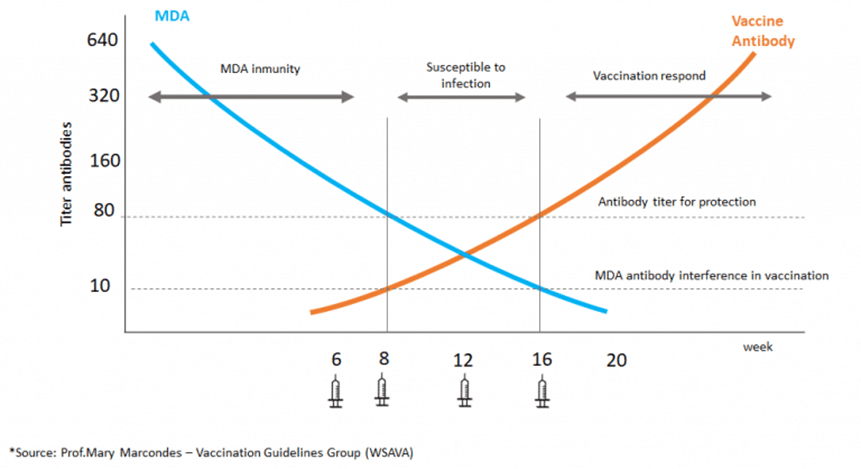
As puppies and kittens grow, the level of maternal antibodies in their systems gradually decreases over time. This decline typically follows a specific pattern:
- First Few Weeks: In the first few weeks after birth, maternal antibodies are at their highest level, providing strong protection.
- Waning Immunity: As time goes on, these antibodies begin to fade. The timing can vary based on several factors, including the mother’s health, the quality of her colostrum, her own immunity/vaccination status, and the individual pet’s metabolism.
- Window of Susceptibility: There comes a point—often around 6 to 16 weeks of age—when maternal antibodies are low enough that they no longer provide adequate protection. During this “window of susceptibility,” puppies and kittens are at higher risk for infections as their own immune system still isn’t at full adult protection yet:
Why Vaccination Matters
Unfortunately, our pets are constantly exposed to a variety of extremely serious viruses and bacteria that are life-threatening or outright fatal – particularly things like distemper, parvovirus, leptospirosis, feline leukemia, panleukopenia, and rabies. Many of these have no cure, or the treatment is extraordinarily expensive and invasive.
This is where vaccinations come in and help protect your new baby.
The first vaccines help “train” your pet’s immune system to recognize and fight off specific diseases by developing antibodies of their own, and subsequent boosters then strengthen and prolong this immunity. Because maternal antibodies can interfere with the effectiveness of vaccines, and we have no way of knowing at which point in that individual pet’s development those maternal antibodies drop off. Every single pet is different. So we base it on the average time frame for the majority of all breeds and develop a vaccination schedule with multiple boosters that provides the best chance to ensure your pet builds strong, lasting immunity.
Who Determines Vaccine Schedules
The governing bodies in veterinary medicine — the American Animal Hospital Association (AAHA), the American Veterinary Medical Association (AVMA), and the American Association of Feline Practitioners (AAFP) – provide the recommended vaccine schedules that we go by here in the U.S., based on the most current research and studies. These guidelines are regularly reviewed to ensure we are still following best practices. Vaccines are then administered every 3 weeks, as this is the standard time frame which studies have shown that their bodies need in order to produce an adequate immune response, as well as watch for any potential adverse reactions. These adverse reactions are rare.
Core vs. Non-Core Vaccines
Core vaccines are recommended for all pets, regardless of their lifestyle or environment, due to the severity and life-threatening nature of the diseases they protect against.
Non-Core vaccines are recommended based on the pet’s risk of exposure to specific diseases, which can depend on factors like geographic location, lifestyle, and environment.

Core Puppy Vaccines:
DHPP* – Distemper, Hepatitis, Parvovirus, and Parainfluenza
DA2PP/DAPP – Distemper, Adenovirus, Parvovirus, Parainfluenza
These are essentially the same vaccine, just made by different manufacturers. Adenovirus is the specific virus that they are vaccinating for to protect against Hepatitis.
*Sometimes you may also see “DHLPP”, which is a DHPP vaccine combo that also includes Leptospirosis vaccine in it as well.
Leptospirosis – Recommended for dogs that may be exposed to contaminated water or environments, as this bacteria is spread through the urine of other animals and wildlife, and is the most common zoonotic (passed to humans) infection in the world. Just like Bordetella, Lepto was long considered “Non-Core”, but we always advised giving it unless a pet has shown in the past that they have an adverse reaction to it, and in 2024 AAHA officially changed it to a Core vaccine.
Rabies – Protects against the rabies virus.
Non-Core Puppy Vaccines:
Bordetella bronchiseptica – Protects against the bacteria that causes “kennel cough”, which is an upper respiratory infection transmitted from dog to dog via respiratory droplets in the air. Despite the inaccurate name, it is not limited to just kennels and can also be spread at dog parks, pet stores, regular parks, boarding facilities, groomers, play dates with other dogs, and even your vet’s waiting area/lobby. While this one is “Non-Core”, we do always advise administering it due to prevalence.
Lyme disease – Recommended for dogs at risk of tick exposure in certain areas of the U.S. where some species of ticks carry the blood-borne bacteria.
Canine influenza – Recommended for dogs in high-risk environments, such as kennels, shelters, boarding facilities, dog shows, or who frequent places similar to the ones where Bordetella is a risk.
AAHA Puppy Vaccination Schedule
6-8 weeks:
- DHPP or DA2PP/DAPP – Initial Vaccine
- Bordetella (depending on risk)
10-12 weeks:
- DHPP or DA2PP/DAPP – Booster #2
- Rabies (only if 12 weeks)
- Leptospirosis (depending on risk)
- Canine Influenza (depending on risk)
14-16 weeks:
- DHPP or DA2PP/DAPP – Booster #3
- Rabies (only if not given at 12 weeks)
- Bordetella (depending on risk, only if not given earlier)
12-16 Months:
- DHPP or DA2PP/DAPP – Final Booster
- Rabies – Final Booster
Every 1-3 years after, depending on vaccine type/manufacturer:
- DHPP or DA2PP/DAPP
- Rabies
Some veterinarians prefer to follow a slightly different, more simplified 6, 9, 12, and 15 week schedule for puppies, which is also acceptable. The goal with this schedule is to be more precise in timing, aim to hit the 2 final doses between 12-15 weeks for maximum immunity, and follow the 3-week gap needed between boosters for the most effective immune response. It generally goes as follows:
6 weeks:
- DHPP or DA2PP/DAPP – Initial Vaccine
9 weeks:
- DHPP or DA2PP/DAPP – Booster #2
12 weeks:
- DHPP or DA2PP/DAPP – Booster #3
- Rabies
- Leptospirosis (depending on risk, may opt for DHLPP combo) – Initial Vaccine
15 weeks:
- DHPP or DA2PP/DAPP – Booster #4
- Rabies (only if not given at 12 weeks)
- Leptospirosis (depending on risk, may opt for DHLPP combo) – Booster #2
- Bordetella (depending on risk)
12-16 Months:
- DHPP or DA2PP/DAPP – Final Booster
- Rabies – Final Booster
Every 1-3 years after, depending on vaccine type/manufacturer:
- DHPP or DA2PP/DAPP
- Rabies

Core Kitten Vaccines:
FVRCP – Feline Viral Rhinotracheitis (caused by feline herpesvirus), Calicivirus, Panleukopenia (feline parvovirus)
Rabies – Protects against the rabies virus.
Non-Core Kitten Vaccines:
Feline Leukemia (FeLV) – Protects against FeLV, which is a highly contagious viral blood cancer that is transmitted from cat to cat via body secretions – respiratory droplets, saliva, urine, feces, blood – through sneezing, coughing, mutual grooming, shared water/food sources, shared litterboxes, and also through fighting and mating. Recommended for kittens that are at risk of exposure, particularly if they go outdoors, are exposed to foster cats and rescues coming into the home, board often, get groomed, show in TICA/CFA cat shows, or if they live in multi-cat households.
Feline Immunodeficiency Virus (FIV) – Protects against FIV, which is the feline form of the human HIV, and is transmitted cat to cat via deep penetrating bite wounds, mating, or blood contact. Uncommonly given and only recommended for kittens who are at risk of exposure by going outdoors, are exposed to foster cats and rescues coming into the home, or who live with an FIV+ cat in a multi-cat household.
Chlamydia felis – Protects against the feline-specific Chlamydia bacteria which causes severe infection of the conjunctiva (mucous membranes) of the eyes as well as the upper respiratory system. Recommended generally only for kittens coming into a multi-cat household where Chlamydia infection is already confirmed, to prevent further spread.
Bordetella bronchiseptica – Protects against the bacteria that causes “kennel cough” in cats, which like dogs is an upper respiratory infection transmitted from cat to cat via respiratory droplets in the air. It also can be transmitted from dog to cat. Despite the inaccurate name, it is not limited to just kennels but also shelter and rescue environments, groomers, cat shows, etc. This vaccine is reserved primarily for kittens at high risk (show cats) as well as populations where the disease is already confirmed and is used to stop the spread.
AAFP and AAHA Kitten Vaccination Schedule
6-8 Weeks:
- FVRCP – Initial Vaccine
- FeLV – Initial Vaccine (depending on risk)
10-12 Weeks:
- FVRCP – Booster #2
- Rabies (only if 12 weeks)
- FeLV – Booster #2 (depending on risk)
- Bordetella (depending on risk)
14-16 Weeks:
- FVRCP – Booster #3
- Rabies (only if not given at 12 weeks)
- FeLV – Booster #3 (depending on risk)
12 Months:
- FVRCP – Final Booster
- Rabies – Final Booster
- FeLV – Final Booster
Every 1-3 years after, depending on vaccine type/manufacturer:
- FVRCP
- Rabies
- FeLV (depending on risk)
Just like with puppies, some veterinarians prefer to follow a slightly different, more simplified 9, 12, and 15 week schedule for kittens, which is also acceptable. The goal with this schedule is to avoid the 6-8 week vaccine due to longer lasting feline maternal antibodies, be more precise in timing, aim to hit the 2 final doses between 12-15 weeks for maximum immunity, and follow the 3-week gap needed between boosters for the most effective immune response. It generally goes as follows:
9 Weeks:
- FVRCP – Initial Vaccine
12 Weeks:
- FVRCP – Booster #2
- Rabies
- FeLV – Initial Vaccine (depending on risk)
- Bordetella (depending on risk)
15 Weeks:
- FVRCP – Booster #3
- Rabies (only if not given at 12 weeks)
- FeLV – Booster #2 (depending on risk)
12 Months:
- FVRCP – Final Booster
- Rabies – Final Booster
- FeLV – Final Booster (depending on risk)
Every 1-3 years after, depending on vaccine type/manufacturer:
- FVRCP
- Rabies
- FeLV (depending on risk)
Your veterinarian will provide a vaccination schedule tailored to your pet’s needs. It’s important to stick to this schedule to ensure they receive all necessary boosters on time and get the maximum protection possible.
It is also important to avoid taking your pet anywhere outside the home or exposing them to other animals until they have finished all booster sets by 15-16 weeks of age AND have been given that necessary extra 3 weeks for those final boosters to take effect and produce the desired immune antibody response – meaning they can now safely have playdates, visit the groomer, attend puppy training classes, and go shopping at PetSmart or Petco with you around 18-19 weeks old. Doing so before they have full immunity puts them at immense risk.
Keeping up with your puppy or kitten’s vaccinations is the single most effective way to ensure they grow up healthy and safe. Talk to your veterinarian about their vaccination schedule and any questions you may have. Your furry friend’s long-term health depends on it!

 Vibes from a Veterinary Nurse